

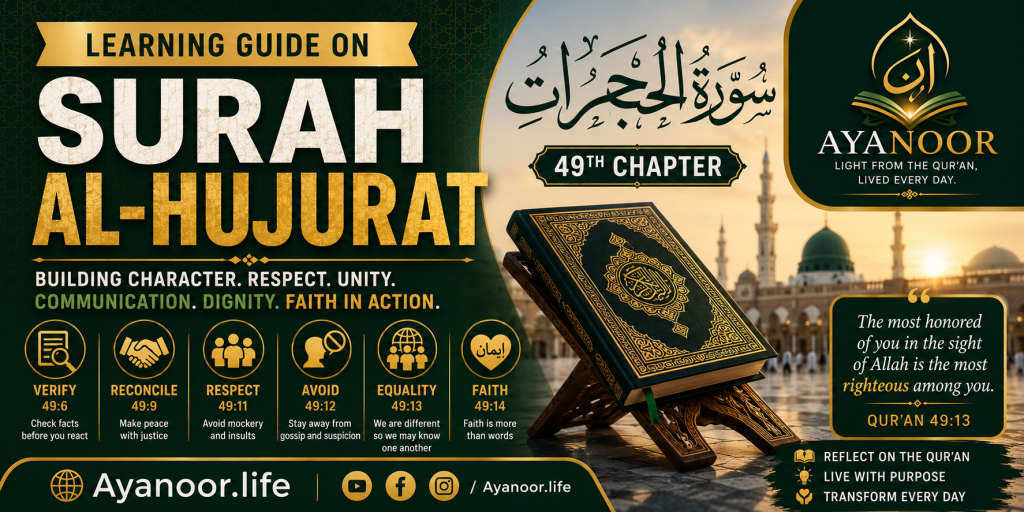
A Learning Guide on Character, Respect, Unity, Communication, and Human Dignity
Surah Al-Hujurat is the 49th chapter of the Qur’an and is often described as one of the greatest chapters concerning human behavior, social ethics, manners, and community life.
The Surah teaches believers:
- how to speak,
- how to verify information,
- how to resolve conflict,
- how to treat one another with dignity,
- and how to build healthy families and societies.
Unlike many Surahs that focus heavily on laws or historical events, Surah Al-Hujurat focuses deeply on:
- character,
- emotional intelligence,
- communication,
- humility,
- and social responsibility.
It teaches that true faith is reflected not only in worship, but also in how we treat people.
1. Respect for Allah and His Messenger ﷺ
The Surah begins by teaching believers proper respect toward Allah and Prophet Muhammad ﷺ.
“O you who believe, do not put yourselves before Allah and His Messenger…”
— Qur’an 49:1
This verse teaches humility and discipline:
- believers should not let ego dominate revelation,
- personal desires should not override divine guidance.
Allah also instructed believers not to raise their voices above the Prophet ﷺ.
“O you who believe, do not raise your voices above the voice of the Prophet…”
— Qur’an 49:2
Reflection
The lesson extends beyond physical voice:
- respect sacred knowledge,
- avoid arrogance,
- and approach truth with humility.
Today many people react emotionally before understanding properly. The Surah teaches patience, wisdom, and respectful dialogue.
2. Verify Information Before Reacting
One of the most important social principles in the Qur’an appears in Surah Al-Hujurat:
“O you who believe, if a sinful person brings you news, verify it…”
— Qur’an 49:6
This verse is extremely relevant in modern times.
Reflection
Today false information spreads rapidly through:
- social media,
- gossip,
- emotional reactions,
- edited clips,
- and assumptions.
Many relationships, reputations, and communities are damaged because people react before verifying facts.
The Qur’an teaches believers:
- investigate carefully,
- avoid emotional judgment,
- and seek truth before responding.
This verse is one of Islam’s greatest foundations for responsible communication.
3. Believers Should Reconcile Conflicts
Allah commands believers to actively resolve disputes within the community.
“And if two groups among the believers fight, make peace between them…”
— Qur’an 49:9
The Qur’an encourages:
- reconciliation,
- justice,
- fairness,
- and healing divisions.
Reflection
Many families and communities today remain broken because:
- pride prevents apology,
- anger replaces wisdom,
- and people prefer winning arguments over restoring relationships.
Surah Al-Hujurat teaches believers to become peacemakers, not fuelers of division.
4. Mockery and Insults Destroy Brotherhood
Allah strongly warns believers against humiliating or mocking others.
“Let not one group ridicule another group…”
— Qur’an 49:11
The verse also forbids:
- insulting nicknames,
- humiliation,
- and belittling people.
Reflection
Modern culture often normalizes:
- sarcasm,
- public humiliation,
- online bullying,
- and ridicule for entertainment.
But the Qur’an reminds believers that dignity matters deeply.
Sometimes a person being mocked may actually be better in the sight of Allah than the one mocking them.
5. Avoid Suspicion, Spying, and Backbiting
One of the most powerful ethical teachings in the Qur’an appears in this Surah:
“Avoid much suspicion… and do not spy or backbite one another…”
— Qur’an 49:12
Allah then gives a deeply emotional comparison:
“Would one of you like to eat the flesh of his dead brother?”
— Qur’an 49:12
Reflection
This verse teaches the seriousness of:
- gossip,
- character assassination,
- rumor-spreading,
- and unhealthy suspicion.
Today many people:
- constantly monitor others,
- spread private matters,
- or discuss others negatively behind their backs.
Surah Al-Hujurat teaches believers to protect dignity, privacy, and trust.
6. Human Diversity Is Part of Allah’s Design
One of the most famous verses of the Qur’an appears in this Surah:
“O mankind, indeed We created you from a male and female and made you into peoples and tribes so that you may know one another…”
— Qur’an 49:13
Allah explains that:
- diversity is intentional,
- nations and tribes exist for understanding,
- not superiority.
The verse continues:
“Indeed, the most honored of you in the sight of Allah is the most righteous among you.”
— Qur’an 49:13
Reflection
The Qur’an rejects:
- racism,
- tribal arrogance,
- nationalism based on superiority,
- and discrimination.
Honor in Islam is not based upon:
- race,
- language,
- wealth,
- or social status.
True honor comes from:
- character,
- sincerity,
- righteousness,
- and humility.
7. Faith Is More Than Words
Allah distinguishes between verbal claims and genuine faith.
“The Bedouins say, ‘We believe.’ Say, ‘You have not yet believed; rather say, We have submitted, for faith has not yet entered your hearts.’”
— Qur’an 49:14
This teaches that faith is:
- not merely identity,
- not cultural labeling,
- and not external appearance alone.
True faith transforms:
- behavior,
- intentions,
- speech,
- and relationships.
Reflection
Many people claim strong belief yet:
- harm others,
- spread gossip,
- lie,
- or behave arrogantly.
The Surah reminds believers that genuine faith should improve character.
8. Allah Knows What Is Hidden
The Surah repeatedly reminds believers that Allah knows:
- intentions,
- sincerity,
- hidden emotions,
- and private actions.
“Indeed, Allah knows the unseen of the heavens and the earth.”
— Qur’an 49:18
Reflection
People can sometimes deceive society outwardly, but sincerity before Allah cannot be faked.
This develops:
- self-awareness,
- accountability,
- humility,
- and sincerity.
Practical Lessons from Surah Al-Hujurat
Personal Lessons
- Speak respectfully
- Verify information carefully
- Avoid gossip and suspicion
- Control arrogance
- Build sincerity in faith
Family Lessons
- Resolve conflicts peacefully
- Avoid humiliation inside the home
- Protect each other’s dignity
- Encourage respectful communication
Community Lessons
- Stop spreading rumors
- Promote reconciliation
- Reject racism and superiority
- Build unity through compassion and justice
Spiritual Lessons
- Faith must improve character
- Allah values sincerity over image
- Humility strengthens the heart
- Respect and mercy are acts of worship
Important Ayahs for Reflection
Verify Information
“If a sinful person brings you news, verify it…”
— Qur’an 49:6
Make Peace
“Make peace between them with justice…”
— Qur’an 49:9
Avoid Mockery
“Let not one group ridicule another…”
— Qur’an 49:11
Avoid Backbiting
“Do not spy or backbite one another…”
— Qur’an 49:12
Human Equality
“The most honored of you in the sight of Allah is the most righteous among you.”
— Qur’an 49:13
Questions for Reflection
- Do I verify information before reacting?
- How do I speak about people when they are absent?
- Am I helping create peace or division?
- Do I treat people with dignity and respect?
- Is my faith improving my character?
- Do I judge people by status or by sincerity?
Conclusion
Surah Al-Hujurat is one of the Qur’an’s greatest guides for building:
- healthy individuals,
- strong families,
- ethical communication,
- and compassionate societies.
It teaches that true believers are not recognized only through worship rituals, but also through:
- honesty,
- humility,
- respect,
- mercy,
- and emotional discipline.
The Surah reminds humanity that:
- words have consequences,
- dignity must be protected,
- unity requires effort,
- and sincerity matters deeply before Allah.
Above all, Surah Al-Hujurat calls believers to become people whose faith is visible through beautiful character and responsible behavior every single day.