

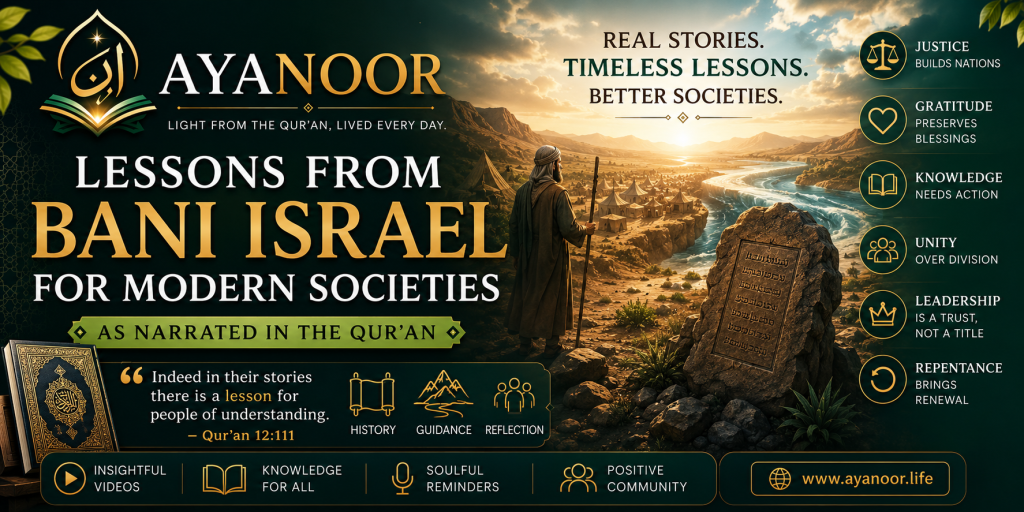
A Learning Guide from the Qur’an
The stories of Bani Israel (the Children of Israel) appear throughout the Qur’an more than any other community. These stories are not narrated to criticize a people or ethnicity, but to provide timeless lessons about human behavior, leadership, morality, faith, gratitude, power, and social decline.
The Qur’an repeatedly reminds believers that the rise and fall of societies is connected to their choices, values, and relationship with justice and truth. The experiences of Bani Israel therefore serve as a mirror for every generation, including Muslims themselves.
Allah says:
“Indeed in their stories there is a lesson for people of understanding.”
— Qur’an 12:111
The Qur’an does not present these stories as ancient history alone. They are warnings, reflections, and guidance for all societies.
1. Freedom Without Discipline Leads to Collapse
One of the greatest miracles experienced by Bani Israel was liberation from the oppression of Pharaoh. Allah rescued them from slavery, humiliation, and fear through Prophet Musa (Moses).
Yet shortly after gaining freedom, many among them began complaining, doubting, and losing gratitude despite witnessing extraordinary signs.
The Qur’an shows that freedom alone does not build a healthy society. Freedom must be supported by:
- Responsibility
- Moral discipline
- Patience
- Gratitude
- Collective purpose
Modern societies often focus heavily on rights while neglecting responsibilities. The Qur’an teaches that nations weaken when personal desires become more important than moral principles.
2. Gratitude Protects Communities
Again and again, Allah reminds Bani Israel of the blessings they received:
- Rescue from oppression
- Prophets and revelation
- Food and sustenance
- Guidance and protection
Yet gratitude slowly turned into entitlement for some among them.
One of the major lessons of the Qur’an is that societies decline when blessings are taken for granted. Wealth, technology, political power, and comfort can create arrogance if gratitude disappears.
Modern nations often assume progress alone guarantees success, but the Qur’an reminds humanity that moral decay can exist even within materially successful civilizations.
3. Knowledge Without Action Becomes Dangerous
Bani Israel were given revelation, scholars, and divine guidance. However, the Qur’an repeatedly warns about the danger of possessing knowledge without living by it.
Allah criticizes those who:
- Preached righteousness but ignored it personally
- Changed or concealed truth for worldly gain
- Used religion for status and power
- Focused on ritual while neglecting justice
This is one of the most important lessons for modern religious communities.
Knowledge should produce:
- Humility
- Justice
- Compassion
- Accountability
- Service to humanity
When religion becomes a tool for pride, division, or control, societies lose the spirit of revelation even while preserving its appearance.
4. Excessive Argumentation Weakens Unity
The Qur’an narrates incidents where Bani Israel complicated matters through endless questioning and resistance.
In the story of the cow in Surah Al-Baqarah, a simple instruction became increasingly difficult because of unnecessary argumentation and hesitation.
Modern societies face similar problems:
- Endless political polarization
- Constant conflict over minor issues
- Loss of collective vision
- Intellectual arrogance
- Obsession with criticism rather than solutions
The Qur’an encourages thoughtful reflection but warns against argumentation that destroys sincerity and unity.
5. Leadership Requires Courage and Sacrifice
The story of Talut (Saul) and Jalut (Goliath) teaches that leadership is not based on wealth, family status, or popularity alone.
Many among Bani Israel initially rejected Talut because he lacked worldly prestige. Yet Allah chose him because of knowledge, strength, and capability.
This lesson is deeply relevant today. Modern societies often elevate:
- Wealth
- Celebrity
- Tribal loyalty
- Political influence
Above character, wisdom, and integrity.
The Qur’an teaches that healthy leadership requires:
- Patience
- Moral strength
- Service
- Vision
- Sacrifice
Not merely power or image.
6. Materialism Can Blind Entire Societies
One recurring theme in the Qur’anic stories of Bani Israel is the tendency of some people to prioritize worldly comfort over spiritual commitment.
When asked to struggle, sacrifice, or trust Allah during difficult moments, many hesitated because they feared hardship.
Modern societies face a similar challenge:
- Comfort becoming the highest value
- Success measured only materially
- Spiritual emptiness despite technological advancement
- Fear of sacrifice and responsibility
The Qur’an reminds humanity that civilizations cannot survive on material strength alone. Spiritual and moral foundations are equally essential.
7. Justice Must Apply to Everyone
The Qur’an strongly condemns double standards.
Some among Bani Israel are criticized for:
- Applying laws selectively
- Protecting their own groups unfairly
- Ignoring justice when it conflicted with self-interest
This lesson remains extremely important today.
A society cannot remain stable if:
- Laws favor the powerful
- Corruption becomes normalized
- Truth is manipulated
- Human dignity depends on wealth or status
The Qur’an consistently teaches that justice is the foundation of healthy civilizations.
8. Spiritual Decline Happens Gradually
One of the most powerful lessons from the Qur’an is that societies rarely collapse suddenly.
Spiritual decline usually happens slowly:
- Gratitude weakens
- Morality becomes flexible
- Truth becomes negotiable
- Leadership loses integrity
- Communities divide
- Materialism dominates
- Compassion decreases
Eventually, societies may still appear successful externally while suffering internally from moral emptiness.
The stories of Bani Israel serve as warnings against this gradual erosion.
9. Allah’s Mercy Remains Open
Despite repeated mistakes, the Qur’an also highlights Allah’s mercy toward Bani Israel. Whenever sincere repentance appeared, Allah accepted it.
This is one of the most hopeful lessons in the Qur’an:
No community is beyond reform.
Societies can recover when they:
- Return to justice
- Restore sincerity
- Rebuild trust
- Revive compassion
- Seek truth honestly
- Protect human dignity
The Qur’an does not teach hopelessness. It teaches accountability balanced with mercy.
Reflection Questions
- Why does the Qur’an mention Bani Israel so frequently?
- How can freedom become harmful without responsibility?
- What happens when knowledge is disconnected from action?
- Why are gratitude and humility essential for societies?
- How do modern societies struggle with materialism?
- What qualities should define true leadership?
- How can communities prevent gradual moral decline?
Final Reflection
The stories of Bani Israel in the Qur’an are not meant to create hostility toward any people. They are lessons about human nature, civilization, morality, leadership, and spiritual responsibility.
The Qur’an uses history to teach humanity that every society — including Muslims — can rise through justice, sincerity, gratitude, and humility, or decline through arrogance, division, materialism, and moral corruption.
The message is timeless:
A society’s true strength is not measured only by wealth or power, but by its relationship with truth, justice, mercy, and accountability before Allah.