

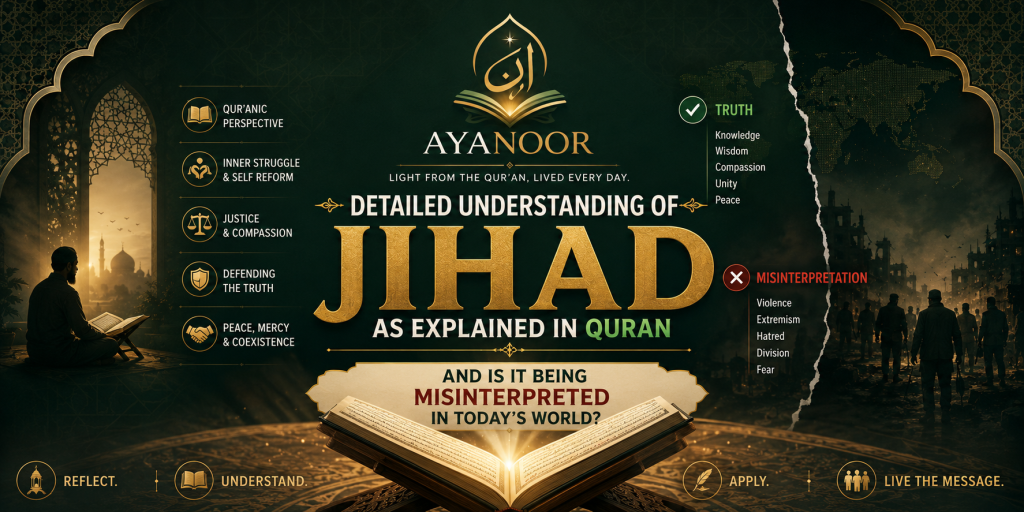
A careful reading of the Qur’an shows that jihad is a broad, principled concept that is often reduced or misrepresented in today’s discussions.
The word jihad literally means striving or exerting effort in the path of Allah. In the Qur’anic sense, it includes multiple dimensions:
- Inner struggle (moral jihad): striving against one’s ego, ظلم (injustice), and wrongdoing—living with honesty, patience, and discipline.
- Struggle through good actions: promoting truth, justice, charity, and social reform.
- Defensive struggle: the Qur’an permits fighting only under strict conditions—primarily self-defense or protection against oppression, not aggression.
Qur’anic Principles on Armed Jihad
When the Qur’an addresses fighting, it sets clear ethical limits:
- Fight only those who fight you (not innocent people)
- Do not transgress limits
- Uphold justice and peace when the enemy inclines to peace
- Protect non-combatants and honor agreements
These teachings show that warfare is conditional, restrained, and morally regulated, not a blanket command.
The Higher Objective
The goal of jihad in the Qur’an is not domination, but:
- Establishing justice
- Ending oppression
- Protecting freedom of belief
It aligns with the Qur’anic emphasis on mercy, fairness, and human dignity.
Misinterpretation in Today’s World
Yes—jihad is often misinterpreted, in two major ways:
- By extremists:
Some groups misuse the concept to justify violence, ignoring the Qur’an’s strict ethical framework and context. They selectively quote verses without understanding their historical background.
- By critics or media narratives:
Jihad is sometimes portrayed as synonymous with “holy war,” which oversimplifies and distorts its true, broader meaning.
The Reality
In essence, jihad is primarily about self-improvement and striving for good, while armed struggle is a limited and last-resort aspect governed by strict moral rules. The disconnect between these teachings and some modern actions is what leads to confusion and negative perceptions.
Can anyone announce Jihad?
In Islam, no individual can simply announce jihad on their own authority. According to the teachings of the Qur’an and the broader Islamic legal tradition, any form of armed struggle is strictly regulated and tied to legitimate authority, justice, and clear conditions.
Key Principles
- Authority matters: Classical Islamic scholarship holds that decisions about armed jihad (i.e., warfare) are made by a legitimate and recognized leadership or state authority, not by private individuals or groups acting independently.
- Defensive context: The Qur’an permits fighting primarily in self-defense or against oppression—not for aggression or personal causes.
- Strict ethics: Even when permitted, there are rules—no harming civilians, no injustice, and a preference for peace if the other side inclines toward it.
Misuse Today
In today’s world, when individuals or groups claim the right to declare jihad on their own, they are misinterpreting and misusing Islamic teachings. Such actions ignore both the ethical framework of the Qur’an and the long-standing scholarly consensus.
Broader Meaning
It’s also important to remember that jihad is not limited to warfare—its primary and everyday meaning is striving for righteousness, self-discipline, and justice.
Leave a Reply