

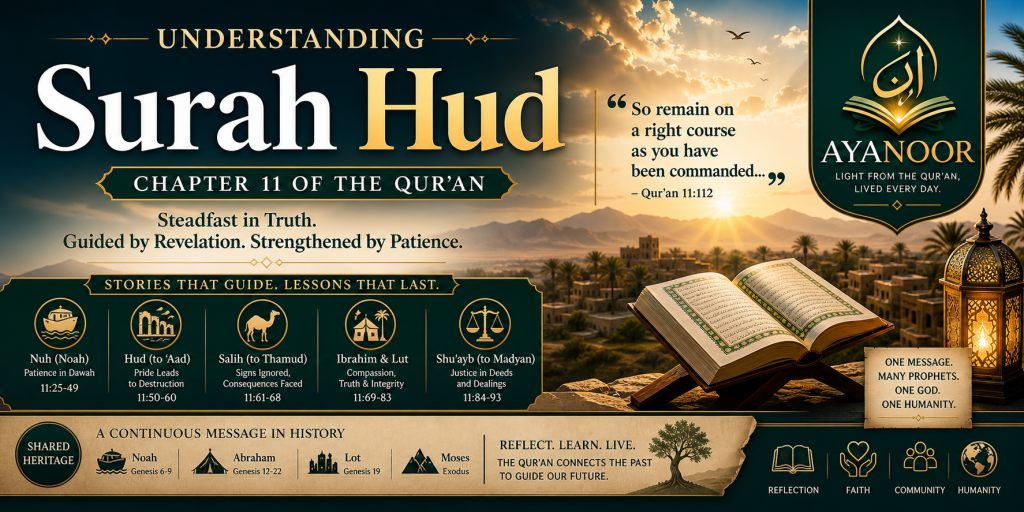
Steadfastness, Truth, and the Continuity of Divine Guidance
Introduction
Surah Hud is the 11th chapter of the Qur’an, revealed in Makkah during a time of intense opposition.
This surah is known for its serious tone and powerful message:
- Stand firm in truth
- Learn from past nations
- Trust in God even in hardship
- Recognize that revelation is part of a continuous divine tradition
It contains detailed accounts of prophets who are also known in earlier scriptures such as the Torah and the Bible.
1. The Call to remain Steadfast with Integrity
The surah begins with a direct command:
“So remain on a right course as you have been commanded…”
(Qur’an 11:112)
Reflection
This verse is central to the surah’s message:
Steadfastness (Istiqamah) is not just belief—it is living truth consistently, even when it is difficult.
2. One Message Across Time
Surah Hud emphasizes that all prophets brought the same core message:
“And We certainly sent Noah to his people…”
(Qur’an 11:25)
“And to ‘Aad [We sent] their brother Hud…”
(Qur’an 11:50)
“And to Thamud [We sent] their brother Salih…”
(Qur’an 11:61)
“And to Madyan [We sent] their brother Shu‘ayb…”
(Qur’an 11:84)
Connection to Older Scriptures
Many of these figures appear in earlier traditions:
- Noah (Nuh) → Found in Genesis (Torah/Bible)
- Abraham (Ibrahim) → Central to all Abrahamic traditions
- Lot (Lut) → Appears in Genesis
- Moses (Musa) → Central figure in the Torah
Reflection
Surah Hud presents revelation not as something new, but as part of a continuous chain of guidance calling humanity back to God.
3. Lessons from Prophet Nuh (Noah)
“I am to you a clear warner…”
(Qur’an 11:25)
Nuh calls his people patiently, but they reject him. Even his own son refuses to believe:
“O my son, come aboard with us…”
(Qur’an 11:42)
But the son chooses otherwise and is lost.
Connection
The story of Noah’s flood is also found in the Torah and Bible (Genesis 6–9).
Reflection
- Faith cannot be inherited—even within families
- Guidance is personal
- Patience in conveying truth is essential
4. The Story of Hud and the People of ‘Aad
“O my people, worship Allah; you have no deity other than Him…”
(Qur’an 11:50)
The people of ‘Aad were powerful and arrogant. They rejected Hud and were ultimately destroyed.
Reflection
Strength and success can lead to arrogance.
The surah reminds us: power without humility leads to downfall.
5. Salih and the People of Thamud
“This is the she-camel of Allah… so leave her to eat within Allah’s land…”
(Qur’an 11:64)
A clear sign is given, but it is rejected and destroyed.
Reflection
When truth becomes clear, rejection is no longer ignorance—it becomes willful denial.
6. Ibrahim (Abraham) and Divine Mercy
“And certainly did Our messengers come to Abraham with good tidings…”
(Qur’an 11:69)
Ibrahim pleads for mercy for the people of Lut:
“Indeed, Abraham was forbearing, grieving, and returning [to Allah].”
(Qur’an 11:75)
Connection
Abraham’s compassion and role appear prominently in the Torah and Bible.
Reflection
True faith is not harsh—it is compassionate, concerned for others, and deeply connected to God.
7. Lut (Lot) and Moral Integrity
“These are my daughters; they are purer for you…”
(Qur’an 11:78)
The people persist in wrongdoing despite clear warnings.
Connection
The story of Lot is also found in Genesis (Torah/Bible).
Reflection
Societies decline when moral boundaries are ignored.
Truth may stand alone—but it must still stand.
8. Shu‘ayb and Economic Justice
“Give full measure and weight in justice…”
(Qur’an 11:85)
Shu‘ayb calls his people to fairness in trade.
Reflection
Faith is not only spiritual—it is ethical.
Business, dealings, and justice are part of worship.
9. The Consequences of Rejecting Truth
“And your Lord would not have destroyed the cities unjustly…”
(Qur’an 11:117)
Reflection
Destruction does not come without warning.
Every community is given opportunities to reflect and return.
10. The Final Message: Trust and Patience
“And be patient, for indeed, Allah does not allow to be lost the reward of those who do good.”
(Qur’an 11:115)
Reflection
The journey of faith is long.
Patience, trust, and consistency are the path forward.
Key Lessons from Surah Hud
- Remain firm and consistent in truth
- Revelation is part of a shared, continuous message
- Past nations are warnings and lessons
- Faith requires patience and resilience
- Moral and social justice are part of faith
- God’s mercy is vast—but accountability is real
Conclusion
Surah Hud is a surah of strength and seriousness. It calls believers—and all readers—to:
- Reflect on history
- Recognize patterns of human behavior
- Stay committed to truth, even when it is difficult
It bridges past and present, showing that the message given to earlier prophets continues in the Qur’an.
Ayanoor Reflection
Light from the Qur’an connects hearts across time.
Surah Hud reminds us that while scriptures were revealed across different eras,
their purpose remains the same:
to guide humanity toward truth, justice, and a sincere relationship with God.
Leave a Reply