
From Darkness to Light: Gratitude, Legacy, and the Message Across Time
Introduction
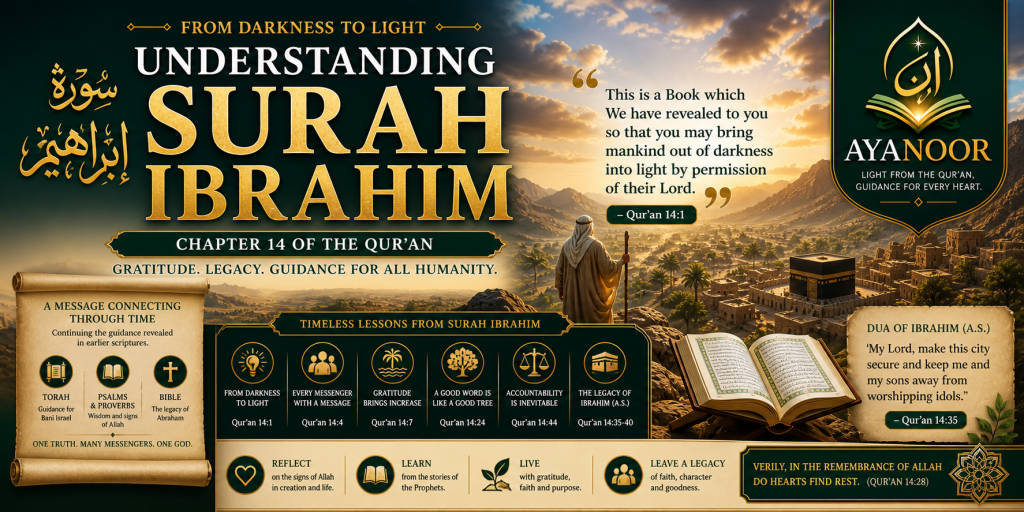
Surah Ibrahim is the 14th chapter of the Qur’an, revealed in Makkah. It centers on the mission of prophets to bring humanity from darkness into light, and highlights the legacy of Prophet Ibrahim (Abraham)—a figure deeply revered across traditions.
This surah connects strongly with themes found in earlier scriptures such as the Torah and the Bible, emphasizing:
- The continuity of divine guidance
- Gratitude vs. ingratitude
- The consequences of belief and rejection
- The enduring legacy of faith
1. A Message for All Humanity: From Darkness to Light
The surah opens with a universal mission:
“[This is] a Book which We have revealed to you so that you may bring mankind out of darkness into light…”
(Qur’an 14:1)
Connection to Older Scriptures
The idea of divine guidance as light appears across traditions:
- In the Bible: “Let there be light” (Genesis 1:3)
- Light is repeatedly associated with guidance and truth
Reflection
Revelation is not meant for one group—it is a universal call to clarity, purpose, and direction.
2. The Mission of Prophets is One
“We sent every messenger with the language of his people…”
(Qur’an 14:4)
Connection
Across the Torah and Bible, prophets speak directly to their communities:
- Moses to the Israelites
- Jesus to his people
- Abraham as a patriarch for many nations
Reflection
The message is consistent, even if the language and context differ:
Know God, follow truth, live righteously.
3. The Story of Musa (Moses): Liberation and Reminder
“And We certainly sent Moses with Our signs, [saying], ‘Bring your people out of darkness into the light…’”
(Qur’an 14:5)
Connection to Older Scriptures
The story of Moses leading his people out of oppression is central in:
- Exodus (Torah/Bible)
Reflection
- Freedom is not just physical—it is spiritual
- True liberation comes through recognizing and worshipping God
4. Gratitude vs. Ingratitude
A key principle is stated:
“If you are grateful, I will surely increase you…”
(Qur’an 14:7)
Reflection
Gratitude is not just words—it is:
- Recognition
- Humility
- Responsible action
Across traditions, gratitude is a foundation of faith.
5. The Consequences of Rejecting Truth
“And they said to their messengers, ‘We will surely drive you out…’”
(Qur’an 14:13)
Connection
Prophets in earlier scriptures also faced rejection:
- Moses faced Pharaoh
- Abraham was opposed by his people
- Jesus faced denial and hostility
Reflection
Truth often meets resistance.
But history shows that truth ultimately prevails.
6. The Parable of the Good Tree
“A good word is like a good tree, whose root is firmly fixed and its branches reach the sky.”
(Qur’an 14:24)
“And the example of a bad word is like a bad tree…”
(Qur’an 14:26)
Connection
The imagery of trees representing faith and life appears in:
- Psalms and Proverbs (Bible)
Reflection
Faith is like a tree:
- Rooted deeply
- Growing steadily
- Bearing fruit over time
7. The Day of Accountability
“And warn mankind of the Day when the punishment will come to them…”
(Qur’an 14:44)
Reflection
All traditions emphasize accountability:
- Actions matter
- Justice will be established
- Choices have consequences
8. The Legacy of Ibrahim (Abraham)
The heart of the surah is the دعا (supplication) of Ibrahim:
“My Lord, make this city secure and keep me and my sons away from worshipping idols.”
(Qur’an 14:35)
“My Lord, indeed I have settled some of my descendants in an uncultivated valley…”
(Qur’an 14:37)
“My Lord, make me an establisher of prayer…”
(Qur’an 14:40)
Connection to Older Scriptures
Abraham is a central figure in:
- Judaism (Torah)
- Christianity (Bible)
- Islam (Qur’an)
He represents:
- Faith
- Trust
- Legacy
Reflection
Ibrahim’s دعا teaches us:
- Faith is personal
- Legacy is intentional
- Parenting includes spiritual responsibility
9. The Illusion of This World
“Do not think that Allah is unaware of what the wrongdoers do…”
(Qur’an 14:42)
Reflection
Apparent success or power is temporary.
Ultimate justice belongs to God.
10. The Final Message: A Universal Reminder
“This [Qur’an] is a message for mankind…”
(Qur’an 14:52)
Reflection
The message is clear and universal:
- Know God
- Reflect deeply
- Live responsibly
Key Lessons from Surah Ibrahim
- Revelation brings humanity from darkness to light
- All prophets share a unified message
- Gratitude leads to growth
- Faith must be rooted and lived
- History teaches patterns of rejection and truth
- Legacy matters—especially through family and دعا
- Accountability is inevitable
Conclusion
Surah Ibrahim is a surah of clarity and continuity.
It connects:
- Past and present
- Prophets and people
- Revelation and responsibility
It reminds us that the message of God has always been the same—
calling humanity toward truth, gratitude, and lasting light.
Ayanoor Reflection
Light from the Qur’an continues a message that has guided humanity across generations.
Surah Ibrahim teaches us that:
- Faith is not just belief—it is legacy
- Gratitude is not just emotion—it is action
- And guidance is not new—it is a continuation of a timeless truth
Leave a Reply