

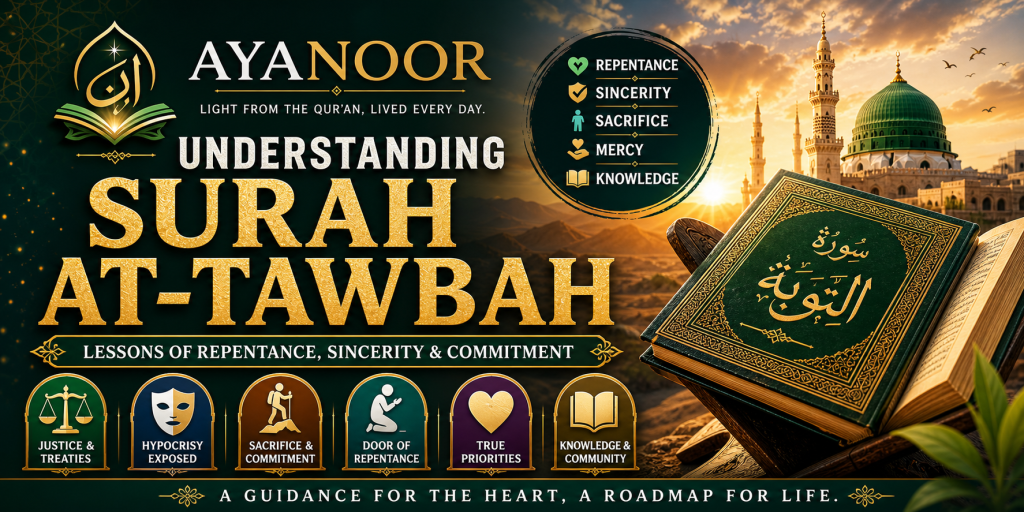
Surah At-Tawbah (The Repentance) is the 9th chapter of the Qur’an, revealed in Madinah during a critical phase of the Muslim community’s development. It addresses themes of accountability, sincerity, justice, and repentance, particularly in the context of treaties, hypocrisy, and the expedition of Tabuk.
Notably, it is the only Surah that does not begin with “Bismillah”, signaling the seriousness of its subject matter.
The Reality of Commitments & Justice
The Surah opens with a declaration regarding treaties with those who repeatedly violated agreements.
📌 Key Ayah:
“This is a declaration of disassociation from Allah and His Messenger…” (9:1)
📌 Balance of Justice:
“Excepted are those with whom you made a treaty and they have not failed you…” (9:4)
🔍 Lesson:
Islam emphasizes honoring agreements, but also allows firmness when trust is broken. Justice is not blind leniency—it is balanced accountability.
Standing Firm Against Hypocrisy
A major theme is exposing the behavior of hypocrites (Munafiqoon)—those who outwardly claim faith but inwardly oppose it.
📌 Key Ayah:
“They swear by Allah that they are of you, but they are not of you…” (9:56)
📌
“The hypocrites, men and women, are of one another…” (9:67)
🔍 Lesson:
Faith is not just words—it requires integrity, consistency, and sincerity. The Surah calls for self-reflection: Are our actions aligned with our beliefs?
The Call to Sacrifice & Commitment
During the Expedition of Tabuk, believers were tested through extreme hardship.
📌 Key Ayah:
“Go forth, whether light or heavy, and strive with your wealth and your lives…” (9:41)
📌
“Those who were left behind rejoiced…” (9:81)
🔍 Lesson:
True faith demands effort and sacrifice, especially when it is inconvenient. Comfort often reveals the difference between sincerity and hypocrisy.
The Door of Repentance is Always Open
Despite its strong tone, the Surah repeatedly emphasizes Allah’s mercy and acceptance of repentance.
📌 Key Ayah:
“Then Allah turned to them so they could repent. Indeed, Allah is the Accepting of repentance, the Merciful.” (9:118)
📌
“Do they not know that it is Allah who accepts repentance…” (9:104)
🔍 Lesson:
No matter how serious the mistake, returning sincerely to Allah is always possible. Accountability is paired with mercy.
Wealth, Power & True Priorities
The Surah warns against letting worldly attachments override faith.
📌 Key Ayah:
“Say, if your fathers, your sons… and wealth you have acquired are more beloved to you than Allah…” (9:24)
🔍 Lesson:
Islam does not reject worldly life—but it demands clear priorities. Faith must remain at the center.
The Role of Knowledge & Community
Not everyone is meant to go to battle—some must stay behind to learn and teach.
📌 Key Ayah:
“And it is not for the believers to go forth all at once…” (9:122)
🔍 Lesson:
A balanced society requires both action and knowledge. Education is a communal obligation.
The Character of the Prophet ﷺ
The Surah concludes by highlighting the mercy and concern of Prophet Muhammad.
📌 Key Ayah:
“There has certainly come to you a Messenger from among yourselves…” (9:128)
🔍 Lesson:
The Prophet ﷺ embodied care, compassion, and deep concern for humanity—setting the ultimate example of leadership.
Key Takeaways from Surah At-Tawbah
- Faith requires sincerity, not just outward identity
- Justice must be balanced with mercy
- Commitment is tested in difficulty
- Repentance is always open
- Worldly attachments should not overpower faith
- Knowledge and action must coexist
Reflection Questions
- Am I consistent between what I believe and how I act?
- Do I prioritize comfort over commitment?
- When I make mistakes, do I turn back sincerely?
- What role do I play—learning, teaching, or supporting?
Leave a Reply