

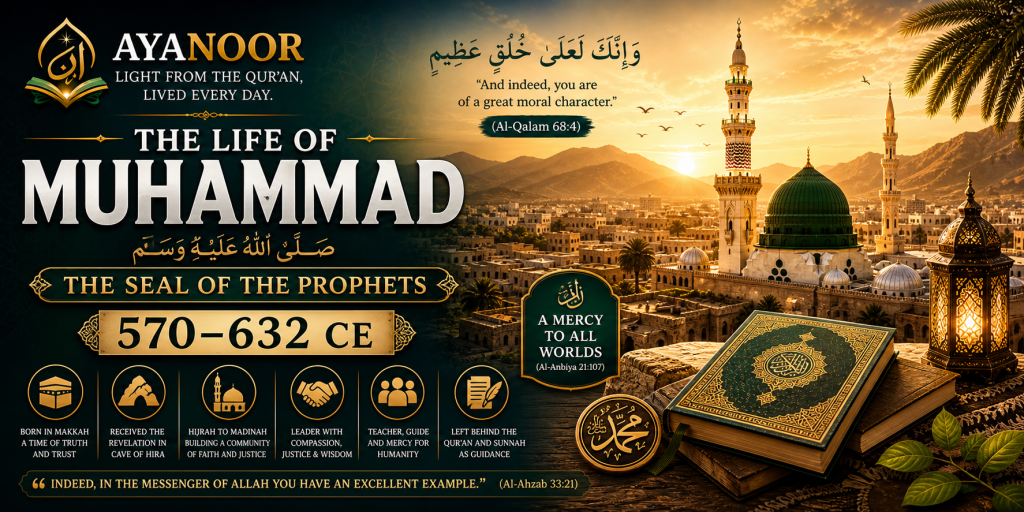
A Model of Mercy, Character, and Purpose
The life of Muhammad (peace be upon him) is not just a historical account—it is a complete model for how to live with purpose, integrity, and compassion. Through him, Allah revealed the Qur’an, a guidance for all of humanity.
His life represents the living embodiment of the Qur’an—a practical demonstration of its teachings.
1. A Birth of Promise in a Time of Darkness
Prophet Muhammad (PBUH) was born in Makkah around 570 CE, a time often described as an age of ignorance (Jahiliyyah), marked by:
- Tribal conflicts
- Social injustice
- Idolatry and moral decline
Even before prophethood, he was known for his character:
- Al-Ameen (The Trustworthy)
- As-Sadiq (The Truthful)
This teaches us:
Great missions are built on strong character long before recognition comes.
2. The Beginning of Revelation
At the age of 40, while reflecting in the Cave of Hira, he received the first revelation:
“Read in the name of your Lord who created…”
— Surah Al-‘Alaq (96:1)
This moment changed the course of history. It marked:
- The beginning of prophethood
- The revival of Tawheed (Oneness of Allah)
- A call toward knowledge and awareness
Initially overwhelmed, the Prophet (PBUH) found comfort in his wife Khadijah (RA), showing:
- The importance of support systems
- The human side of even the greatest leaders
3. The Early Struggles in Makkah
The message of Islam challenged the existing social and religious order. As a result, the Prophet (PBUH) and his followers faced:
- Mockery
- Boycotts
- Persecution
Despite this, the Qur’an reminded him:
“So be patient, as were those of determination among the messengers…”
— Surah Al-Ahqaf (46:35)
His response was never revenge—but patience, wisdom, and resilience.
4. A Mercy to All Worlds
Allah describes the Prophet (PBUH) in a powerful way:
“And We have not sent you, [O Muhammad], except as a mercy to the worlds.”
— Surah Al-Anbiya (21:107)
His mercy extended to:
- Friends and enemies
- The poor and the powerful
- Humans and even animals
This teaches:
True strength lies in compassion, not dominance.
5. The Migration (Hijrah): A Turning Point
After years of persecution, the Prophet (PBUH) migrated from Makkah to Madinah. This was not just a physical journey—it was a strategic and spiritual transformation.
In Madinah, he:
- Built a community based on justice and faith
- Established brotherhood between migrants and locals
- Created a system of governance rooted in ethics
This shows:
Faith must eventually translate into systems, society, and structure.
6. Leadership with Justice and Humility
As a leader, the Prophet (PBUH):
- Led battles when necessary
- Forgave even his strongest enemies
- Lived a simple life despite authority
The Qur’an highlights his character:
“And indeed, you are of a عظیم (great) moral character.”
— Surah Al-Qalam (68:4)
He was:
- A leader without arrogance
- A teacher without harshness
- A servant of Allah before anything else
7. The Return to Makkah: Victory with Forgiveness
When the Prophet (PBUH) returned to Makkah as a victor, he had the power to take revenge. Instead, he declared:
“No blame will there be upon you today.”
This moment defines his legacy:
- Victory without oppression
- Power with humility
- Justice with mercy
8. The Final Message
In his final sermon, the Prophet (PBUH) emphasized:
- Equality of all البشر (humans)
- Rights of women
- Justice and accountability
- Holding firmly to the Qur’an
Allah confirms the completion of the message:
“This day I have perfected for you your religion…”
— Surah Al-Ma’idah (5:3)
9. A Living Example for Humanity
Allah makes it clear:
“Indeed in the Messenger of Allah you have an excellent example…”
— Surah Al-Ahzab (33:21)
His life is not meant to be admired from a distance—it is meant to be:
- Studied
- Understood
- Lived
Key Lessons from the Life of Prophet Muhammad (PBUH)
1. Character is the foundation of impact
Before revelation, he was already known for integrity.
2. Patience is essential in every mission
Great change takes time and resilience.
3. Mercy is the highest form of strength
His kindness defined his success.
4. Leadership requires humility
Despite authority, he lived simply.
5. Faith must shape daily life
Islam is not just belief—it is practice.
Conclusion
The life of Prophet Muhammad (PBUH) is a complete blueprint for humanity—guiding us in:
- Personal conduct
- Relationships
- Leadership
- Spiritual connection
For Ayanoor’s vision—“Light from the Qur’an, lived every day”—his life shows us how to translate divine guidance into everyday living.
He was not just a messenger of the Qur’an—
He was the Qur’an in action.
Leave a Reply