
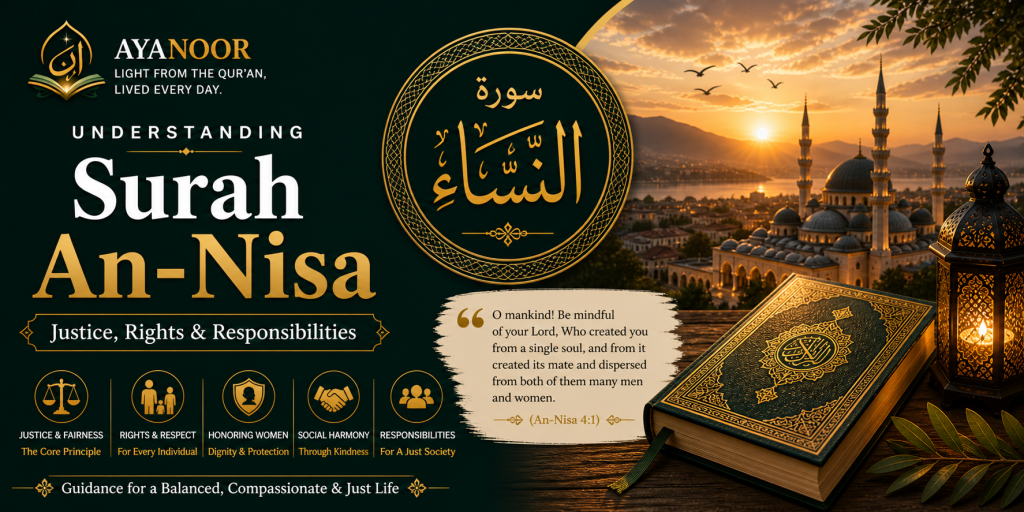
- Meaning: “The Women”
- Position: 4th chapter of the Quran
- Revelation: Mostly in Medina
- Main focus: Social justice, family law, rights, and governance
👉 This surah is one of the most detailed in addressing how a just society should function, especially regarding vulnerable groups.
Core Themes & Explanation
1. Rights and Protection of Women
- Establishes rights in:
- Marriage
- Inheritance
- Financial security
👉 In a 7th-century context, these were major reforms:
- Women given legal identity and property rights
2. Family Structure & Responsibilities
- Emphasizes:
- Fair treatment in marriage
- Responsibility of spouses
- Conflict resolution
👉 Promotes balance, responsibility, and fairness within families
3. Protection of Orphans
- Strong warnings against:
- Misusing orphan wealth
- Exploiting the weak
👉 One of the most repeated concerns in this surah
4. Justice & Fairness
- Commands believers to:
- Stand firmly for justice
- Be truthful even against themselves
👉 Justice is universal and non-negotiable
5. Law & Governance
- Lays down principles for:
- Leadership
- Trust (Amanah)
- Obedience to lawful authority
👉 Encourages accountable and ethical governance
6. Social Responsibility
- Care for:
- Poor
- Needy
- Relatives
- Neighbors
👉 Builds a compassionate society
7. Warning Against Hypocrisy
- Criticizes those who:
- Pretend belief
- Undermine justice
👉 Highlights danger of hidden corruption
8. Dialogue with People of the Book
- Addresses beliefs about:
- Jesus
- Clarifies Islamic stance:
- Jesus as a prophet, not divine
9. Rules Related to Conflict & Security
- Provides guidance on:
- Self-defense
- Conduct during conflict
👉 Emphasizes:
- Justice even in war
- Protection of innocents
Key Teachings (Simple)
✔ Protect the weak (women, orphans, poor)
✔ Uphold justice in all situations
✔ Maintain fairness in family life
✔ Be honest and trustworthy
✔ Build a responsible society
Key Concept: Justice + Responsibility
Surah An-Nisa repeatedly connects:
- Rights with responsibilities
- Power with accountability
Final Insight
This surah is essentially a blueprint for a just society, where:
- The vulnerable are protected
- Families are stable
- Leaders are accountable
- Faith is reflected in real-life actions
A comparison between Surah An-Nisa and modern legal / human rights frameworks (such as those reflected in the United Nations and the Universal Declaration of Human Rights) shows both strong overlaps in core values and important differences in approach and application.
Surah An-Nisa
- Commands absolute justice—even against oneself
- Equality before the law in moral accountability
Modern Human Rights
- Legal equality regardless of race, gender, religion
👉 Common Ground:
- Justice is central
- No ظلم (oppression) allowed
👉 Difference:
- Qur’an grounds justice in divine command
- Modern systems ground it in human consensus & law
2. Women’s Rights
Surah An-Nisa
- Grants:
- Inheritance rights
- Financial security (mahr)
- Protection in marriage
Modern Systems
- Emphasize:
- Full gender equality
- Equal pay, equal rights in all domains
👉 Common Ground:
- Protection of women’s dignity and rights
👉 Difference:
- Qur’anic framework includes gender-specific roles/responsibilities
- Modern frameworks emphasize identical equality
3. Protection of Vulnerable Groups
Surah An-Nisa
- Strong focus on:
- Orphans
- Poor
- Weak
Modern Systems
- Child protection laws
- Social welfare systems
👉 Strong Overlap:
- Both prioritize protecting the vulnerable
- Law & Governance
Surah An-Nisa
- Emphasizes:
- Trust (Amanah)
- Moral leadership
- Accountability before God
Modern Systems
- Based on:
- Constitutions
- Rule of law
- Separation of powers
👉 Difference:
- Qur’anic model = moral + spiritual accountability
- Modern model = institutional accountability
5. Criminal Justice
Surah An-Nisa
- Focus on:
- Fairness
- Evidence
- Proportional justice
Modern Systems
- Due process
- Presumption of innocence
- Codified legal procedures
👉 Common Ground:
- Justice must be fair and evidence-based
6. Social Responsibility
Surah An-Nisa
- Encourages:
- Charity
- Caring for neighbors
- Family responsibility
Modern Systems
- Welfare programs
- Social services
👉 Difference:
- Qur’an emphasizes moral duty & charity
- Modern systems rely more on state responsibility
7. Freedom & Religion
Surah An-Nisa
- Advocates justice and fairness
- Works within a faith-centered society
Modern Human Rights
- Explicitly protects:
- Freedom of religion
- Freedom of expression
👉 Difference:
- Modern systems formalize individual freedoms legally
- Qur’anic framework ties freedom with moral responsibility
Summary Table
| Area | Surah An-Nisa | Modern Human Rights |
| Source | Divine guidance | Human-made law |
| Justice | Moral + legal | Legal/institutional |
| Women | Rights + roles | Equal rights emphasis |
| Vulnerable | Strong protection | Strong protection |
| Governance | Ethical leadership | Systems & institutions |
| Social welfare | Charity-based | State-based |
Final Insight
Surah An-Nisa and modern human rights systems share many ethical goals:
- Justice
- Protection of the weak
- Social fairness
But they differ in:
- Source of authority (God vs human consensus)
- Structure of rights and roles
- Implementation mechanisms
Leave a Reply