
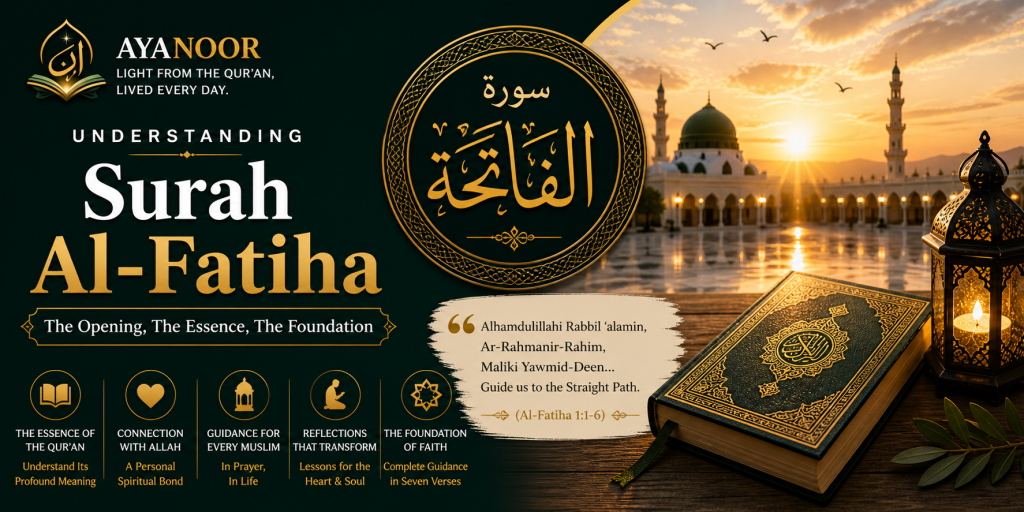
Surah Al-Fatiha is a prayer that praises Allah, acknowledges His authority, and seeks guidance on the straight and righteous path, helping believers live a life pleasing to God.
Key Points:
- Praise and Gratitude to Allah
- The chapter begins by praising Allah, the Most Merciful, the Most Compassionate, and recognizing Him as the Lord of all worlds.
- Acknowledgment of Sovereignty
- Allah is Master of the Day of Judgment, reminding believers of accountability and divine authority.
- Seeking Guidance
- Believers ask Allah to guide them on the straight path, the way of righteousness and faith.
- Distinguishing Right from Wrong
- The chapter requests guidance away from the path of those who go astray or incur Allah’s displeasure.
The Quran presents a clear and nuanced view of earlier holy books. It both affirms their divine origin and comments on how they were later treated by people. Here’s a balanced explanation:
1. Recognition of Earlier Revelations
The Qur’an teaches that God revealed guidance before it, including:
- Tawrat (Torah) given to Moses
- Zabur given to David
- Injil given to Jesus
2. Unity of Message
According to the Qur’an:
- All prophets preached one core message: worship one God and live righteously
- Differences in laws existed, but belief in one God (Tawheed) remained constant
👉 This means Islam sees itself as a continuation, not a new religion.
3. Confirmation & Criterion
The Qur’an describes itself as:
- A confirmation of earlier scriptures
- A criterion (Furqan) to judge between truth and distortion
👉 It validates what remains true and clarifies what may have changed.
4. Concept of Alteration (Tahrif)
The Qur’an suggests that:
- Some followers of earlier books misinterpreted or altered meanings
- Changes were not necessarily the entire text, but:
- Interpretations
- Additions or omissions
- Misapplication of teachings
👉 This is known as tahrif (distortion) in Islamic theology.
5. Respect for “People of the Book”
The Qur’an refers to Jews and Christians as:
- People of the Book
They are given:
- A special status among non-Muslims
- Permission for social interaction (e.g., food, marriage under conditions)
👉 This reflects recognition of shared roots.
6. Call to Common Ground
The Qur’an دعوت (invites) them to:
- Return to pure monotheism
- Follow the original teachings of their prophets
. Preservation of the Qur’an
A key difference emphasized:
- The Qur’an is considered fully preserved
- Earlier scriptures are seen as partially preserved but historically affected
A comparison between the Quran and the Bible is best understood across a few key dimensions: origin, structure, theology, and message
1. Origin & Revelation
Qur’an
- Believed by Muslims to be the literal word of God (Allah)
- Revealed to Muhammad over ~23 years
- Delivered in Arabic through the angel Gabriel
Bible
- Considered inspired by God, written by multiple human authors
- Developed over centuries
- Includes texts from prophets, apostles, and historians
👉 Key difference:
- Qur’an = direct revelation
- Bible = inspired writings
2. Structure & Composition
Qur’an
- Single book with 114 chapters (Surahs)
- Fairly consistent style and voice
Bible
- A collection of books divided into:
- Old Testament
- New Testament
- Written in different styles (history, poetry, letters, prophecy)
👉 Key difference:
- Qur’an = one unified text
- Bible = library of texts
3. Concept of God
Qur’an
- Strict monotheism (Tawheed)
- God is one, indivisible, unique
- No partners, no incarnation
Bible
- Also affirms one God
- Most Christians believe in the Trinity (Father, Son, Holy Spirit)
👉 Key difference:
- Qur’an rejects Trinity
- Bible (Christian interpretation) includes it
4. Jesus (Peace Be Upon Him)
Qur’an
- Jesus is:
- A prophet and messenger
- Born miraculously
- Not divine, not son of God
Bible
- Jesus Christ is:
- Son of God
- Divine savior
- Crucified and resurrected
👉 One of the biggest theological differences
5. Salvation & Guidance
Qur’an
- Salvation through:
- Faith in one God
- Good deeds
- God’s mercy
Bible
- Many Christian teachings emphasize:
- Faith in Jesus as savior
- Grace of God
- Good works as a result of faith
6. Law & Daily Life
Qur’an
- Provides detailed guidance on:
- Worship
- Family law
- Business ethics
- Social rules
Bible
- Contains laws (especially Old Testament)
- New Testament focuses more on:
- Faith
- Morality
- Spiritual teachings
7. Preservation
Qur’an
- Believed to be unchanged since revelation
- Memorized and written in original Arabic
Bible
- Exists in multiple versions and translations
- Manuscripts show variations over time
8. View of Each Other
Qur’an’s View of Bible
- Recognizes earlier revelations like:
- Tawrat
- Injil
- Says they were originally divine but later altered (interpretation varies)
Bible’s View of Qur’an
- Does not mention Qur’an (it predates Islam)
| Topic | Qur’an | Bible |
| Nature | Word of God | Inspired writings |
| Structure | Single book | Collection of books |
| God | Strictly One | One (Trinity in Christianity) |
| Jesus | Prophet | Divine Savior |
| Salvation | Faith + deeds + mercy | Faith (especially in Jesus) |
| Preservation | Fully preserved (Islamic belief) | Multiple versions |
Summary Table
Final Thought
Both texts:
- Teach belief in God
- Promote morality, charity, and justice
- Share many prophets and stories
But they differ significantly in theology and interpretation, especially about Jesus and the nature of God.
Leave a Reply