
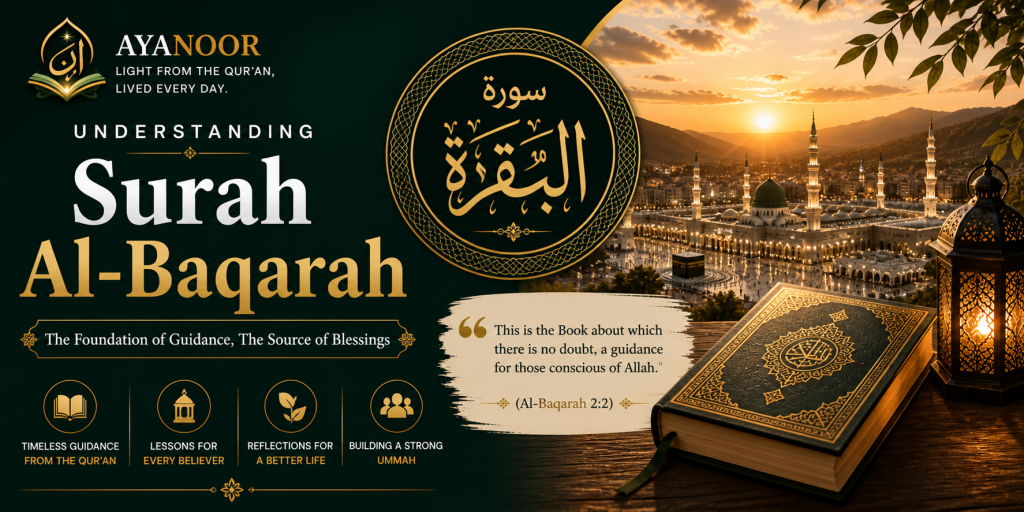
Theme: Faith, guidance, and the opening invitation to live with awareness. Reflection: How do I seek guidance before making decisions?
Surah Al-Baqarah is the longest chapter of the Qur’an and covers a wide range of guidance for Muslims. Its main themes include faith, law, ethics, and guidance for personal and community life.
Surah Al-Baqarah teaches Muslims how to live a life guided by faith, justice, and ethical conduct, offering rules for personal behavior, community life, and worship, while reminding believers of the rewards of obedience and the consequences of wrongdoing.
Key Points:
- Faith and Belief
- Emphasizes belief in Allah, the Day of Judgment, and following His guidance.
- Encourages patience, trust in Allah, and obedience to His commands.
- Guidance for Life
- Provides instructions on prayer, charity, fasting, marriage, family, and business dealings.
- Offers rules for justice, honesty, and fairness in society.
- Stories of Past Communities
- Mentions lessons from previous prophets like Adam, Ibrahim, Musa, and their communities.
- Encourages learning from their obedience or mistakes.
- Law and Governance
- Sets out social, economic, and ethical laws to create a balanced, just society.
- Includes guidance on contracts, financial dealings, and criminal justice.
- Warning Against Disobedience
- Warns against disbelief, hypocrisy, and rejecting Allah’s guidance.
- Emphasizes consequences of wrongdoing while offering mercy for repentance.
- Spiritual and Moral Lessons
- Encourages sincerity, patience, humility, and reliance on Allah.
- Highlights the importance of learning, reflection, and moral conduct.
The Quran presents itself as a complete guide for life, offering direction not just in spirituality but also in personal conduct, relationships, justice, and society. Here’s a clear breakdown of its teachings on “Guidance for Life”:
1. Purpose of Life
- Humans are created to:
- Worship one God
- Live responsibly and ethically
👉 Life is seen as a test, with accountability in the hereafter.
2. Moral & Ethical Guidance
The Qur’an emphasizes:
- Honesty and truthfulness
- Justice and fairness
- Kindness to others
- Keeping promises
👉 Core idea: Good character is central to faith
3. Family & Social Life
- Respect and care for parents
- Rights and responsibilities in marriage
- Protection of children and orphans
- Strong encouragement of community support
👉 Family is the foundation of a healthy society
4. Economic Guidance
- Fair trade and honest business
- Prohibition of exploitation (e.g., usury/interest in traditional interpretation)
- Charity (Zakat) as an obligation
- Helping the poor and needy
👉 Wealth is a trust, not just personal gain
5. Personal Discipline & Spiritual Growth
- Regular prayer (Salah)
- Fasting (especially in Ramadan)
- Patience (Sabr) and gratitude (Shukr)
- Self-control and humility
👉 Focus: inner purification and balance
6. Justice & Accountability
- Stand firmly for justice—even against oneself
- No oppression or ظلم (injustice)
- Equality of all humans before God
👉 Justice is a non-negotiable principle
7. Relations with Others
- Respect for neighbors
- Kindness to strangers
- Fair treatment of all people
👉 Promotes peaceful coexistence
8. Balance in Life
- Avoid extremes
- Balance between:
- Material life
- Spiritual life
👉 Islam promotes a middle path
9. Use of Reason & Reflection
- Encourages thinking, learning, and reflection
- Repeatedly asks people to observe nature and history
👉 Faith and reason are complementary
10. Accountability & Afterlife
- Every action has consequences
- Belief in Day of Judgment
- Reward for good, accountability for wrong
👉 Creates a strong sense of responsibility
Simple Summary
The Qur’an guides life through:
✔ Faith in one God
✔ Strong moral character
✔ Social responsibility
✔ Justice and fairness
✔ Spiritual discipline
The Quran provides foundational principles for law and governance, focusing on justice, accountability, and moral responsibility rather than a rigid political system. Its teachings have guided Islamic legal and political thought for centuries.
Here’s a clear, structured explanation:
1. Justice as the Core Principle
- Justice (‘Adl) is central to governance
- Rulers and citizens must uphold fairness in all matters
👉 The Qur’an emphasizes:
- No bias (even against oneself or relatives)
- Protection of rights for all people
2. Rule of Law (Supremacy of Divine Guidance)
- Laws should be based on divine guidance
- No one is above the law, including leaders
👉 Authority is a trust (Amanah), not absolute power
3. Leadership & Responsibility
- Leaders must be:
- Just
- Honest
- Competent
- Leadership is seen as a moral duty, not privilege
👉 Abuse of power is strongly condemned
4. Consultation (Shura)
- Decision-making should involve consultation
- Encourages participatory governance
👉 Not necessarily modern democracy, but supports collective decision-making
5. Accountability & Transparency
- Leaders are accountable to:
- God
- The people
- Corruption, bribery, and ظلم (injustice) are prohibited
6. Legal Framework (Sharia Foundations)
The Qur’an outlines basic legal principles:
- Criminal justice (e.g., proportional punishment)
- Family law (marriage, inheritance)
- Economic laws (contracts, fairness in trade)
👉 These form the basis of Sharia, later developed by scholars
7. Equality Before the Law
- All humans are equal in justice
- No discrimination based on:
- Wealth
- Status
- Tribe
8. Protection of Rights
- Right to life
- Right to property
- Right to dignity
👉 ظلم (oppression) is strictly forbidden
9. Relations with Non-Muslims
- Justice and fairness toward all
- Protection of religious minorities
- No compulsion in religion
10. War & Peace Governance
- War allowed only in:
- Self-defense
- Protection against ظلم
- Strict rules:
- No harm to civilians
- Seek peace when possible
The Quran repeatedly warns against disobedience—not simply as punishment-focused messaging, but as guidance meant to protect individuals and societies from moral and spiritual harm. These warnings are balanced with themes of mercy, repentance, and accountability.
Here’s a clear breakdown:
1. Meaning of Disobedience (Ma‘ṣiyah)
In the Qur’anic context, disobedience means:
- Rejecting or ignoring God’s guidance
- Acting unjustly or immorally
- Persisting in wrongdoing knowingly
👉 It is not just about rituals, but ethical failure and arrogance
2. Consequences of Persistent Disobedience
Worldly Consequences
- Loss of peace and moral direction
- Social فساد (corruption) and ظلم (oppression)
- Breakdown of families and communities
Hereafter Consequences
- Accountability on the Day of Judgment
- Punishment for unrepented wrongdoing
👉 The Qur’an often uses past nations as warnings (e.g., people of Noah and Lot)
3. Role of Satan (Shaytan)
- Portrayed as one who:
- Encourages disobedience
- Misleads humans gradually
- Humans are warned to be aware and resist temptation
4. Arrogance as Root Cause
A key reason for disobedience:
- Pride and refusal to submit to truth
👉 Example:
- Iblis disobeys God out of arrogance
5. Repeated Warnings Through Prophets
- God sends messengers to guide people
- Disobedience often follows:
- Denial of prophets
- Ignoring clear signs
👉 Stories of prophets serve as lessons and warnings
6. Hardening of Hearts
- Continuous disobedience leads to:
- Loss of sensitivity to truth
- Spiritual blindness
👉 A major Qur’anic concern is becoming morally numb
7. Balance: Warning + Mercy
Despite warnings, the Qur’an emphasizes:
- God’s mercy is always open
- Sincere repentance is accepted
👉 No matter how serious the sin, return is always possible
8. Major Areas of Disobedience Highlighted
- Injustice and ظلم
- Dishonesty and fraud
- Oppression of the weak
- Immorality and فساد
- Rejecting truth knowingly
Simple Summary
The Qur’an warns that disobedience leads to:
- ✔ Moral decline
- ✔ Social harm
- ✔ Spiritual loss
- ✔ Accountability in the hereafter
But also teaches:
- ✔ Awareness
- ✔ Self-control
- ✔ Repentance
✔ Hope in God’s mercy