
Understanding the Rights, Value, and Mercy of Daughters in Islam
One of the most heartbreaking realities in many parts of the subcontinent is the unequal treatment of daughters inside their own homes.
In countless families:
- boys are preferred over girls,
- sons receive better food,
- better education,
- more attention,
- more freedom,
- and more investment in their future.
While daughters are often:
- ignored,
- emotionally neglected,
- treated as burdens,
- deprived of opportunities,
- or made to feel less important.
Sometimes this injustice is so normalized that families no longer even recognize it as wrong.
But Islam came to destroy this mindset.
Because in Islam,
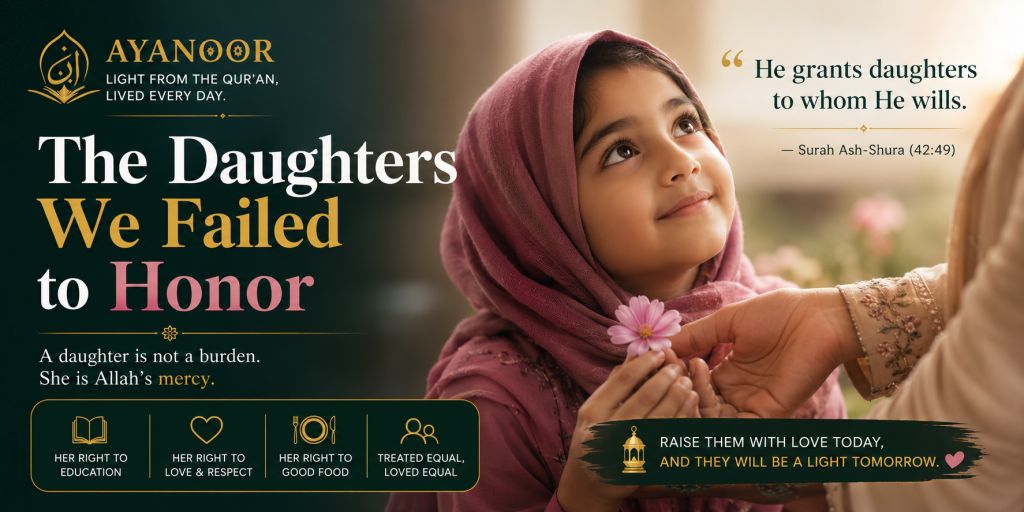
a daughter is not a burden.
She is a mercy from Allah.
The Pain Hidden Inside Many Homes
Many girls grow up silently watching:
- their brothers being prioritized,
- their education taken more seriously,
- better clothes bought for boys,
- better food served to sons,
- and greater emotional affection given to male children.
Some daughters are even told:
- “You will leave this house one day anyway.”
- “Why spend too much on girls?”
- “Sons are the real support.”
These words deeply wound the heart.
And often,
the emotional scars remain for life.
Islam Came to End This Cruelty
Before Islam,
many societies treated daughters with shame and humiliation.
Some even buried baby girls alive.
Then Islam came and transformed this mentality completely.
Allah says in the Qur’an:
“And when the girl who was buried alive is asked for what sin she was killed.”
— Surah At-Takwir 81:8–9
This verse shattered the culture that viewed daughters as unwanted.
Islam elevated the status of girls and women with dignity, compassion, and rights.
Daughters Are a Mercy From Allah
Children are gifts from Allah —
both sons and daughters.
Allah says:
“To Allah belongs the dominion of the heavens and the earth. He creates what He wills. He grants daughters to whom He wills, and grants sons to whom He wills.”
— Surah Ash-Shura 42:49
Notice something beautiful:
In this verse,
Allah mentions daughters FIRST.
This itself is a subtle honor.
A daughter is not a punishment.
Not a burden.
Not bad luck.
She is Allah’s mercy entering a home.
The Prophet ﷺ Loved and Honored Daughters
The Prophet Muhammad ﷺ treated daughters with extraordinary love and respect.
When his daughter Fatimah (RA) entered the room,
he would:
- stand up for her,
- welcome her warmly,
- and seat her in his own place.
This was revolutionary behavior for that society.
The Prophet ﷺ said:
“Whoever has daughters and treats them kindly, they will be a shield for him from the Fire.”
— Sahih al-Bukhari
And he also said:
“Whoever cares for two daughters until they grow up, he and I will come on the Day of Judgment like this.”
— Sahih Muslim
Then he joined his fingers together.
SubhanAllah.
Raising daughters with love and dignity is not a burden —
it is a path to Jannah.
Unequal Treatment Is Injustice
Islam teaches justice inside the family.
Parents are not allowed to show harmful favoritism between children.
Even emotional neglect can damage a child deeply.
A girl who constantly feels:
- less loved,
- less valued,
- less important,
may grow up carrying: - insecurity,
- sadness,
- emotional wounds,
- low self-worth,
- and lifelong pain.
Many daughters suffer silently while smiling outwardly.
Education Is Also Their Right
One of the greatest injustices is depriving girls of education.
Sometimes families invest heavily in sons while treating daughters’ education as unnecessary.
But Islam encourages knowledge for ALL believers.
The Prophet ﷺ said:
“Seeking knowledge is obligatory upon every Muslim.”
— Sunan Ibn Majah
Knowledge:
- builds confidence,
- protects dignity,
- develops understanding,
- and helps women contribute positively to society and family.
An educated daughter can uplift generations.
Food, Care, and Affection Should Be Equal
Some families unconsciously give:
- better food,
- better healthcare,
- better clothing,
- and greater emotional support to sons.
This is painful and unjust.
Children notice these differences very early.
Islam teaches compassion and fairness.
A daughter deserves:
- nourishment,
- affection,
- opportunities,
- emotional safety,
- and respect exactly as sons do.
Daughters Are Not Financial Burdens
Many people fear:
- marriage expenses,
- dowry culture,
- or social expectations.
But these cultural problems should never make parents emotionally distance themselves from daughters.
Sustenance comes from Allah.
Allah says:
“And there is no creature on earth except that upon Allah is its provision.”
— Surah Hud 11:6
Children do not reduce rizq.
They bring barakah.
Emotional Damage Lasts for Years
A child who grows up feeling unwanted may struggle later with:
- confidence,
- relationships,
- emotional wellbeing,
- trust,
- and self-worth.
Sometimes parents provide food and shelter —
but fail to provide emotional love.
Yet children remember emotional treatment for the rest of their lives.
True Success Is Raising Compassionate Families
A successful home is not one that only raises:
- wealthy sons,
- academically successful children,
- or socially respected families.
A truly successful home is one where:
- every child feels valued,
- daughters feel safe and honored,
- love is distributed fairly,
- and children grow emotionally healthy.
Reflection Questions
- Why do some cultures still value sons more than daughters?
- How does unequal treatment affect girls emotionally?
- What does Islam teach about honoring daughters?
- How can families create more emotionally healthy homes?
- What responsibilities do parents have toward all children equally?
Ayanoor Takeaway
A daughter is not:
- a burden,
- a weakness,
- or a disappointment.
She is:
- a trust from Allah,
- a source of mercy,
- a test of character,
- and potentially a means to Jannah.
The way we treat daughters says a great deal about:
- our values,
- our humanity,
- and our understanding of Islam.
Homes filled with fairness,
love,
and compassion
raise stronger human beings for the future.
And sometimes,
the child who was treated as “less important”
becomes the one whose love and dua saves the family in the end.
“He grants daughters to whom He wills.”
— Surah Ash-Shura 42:49
AYANOOR
Light From The Qur’an, Lived Every Day.
Leave a Reply