

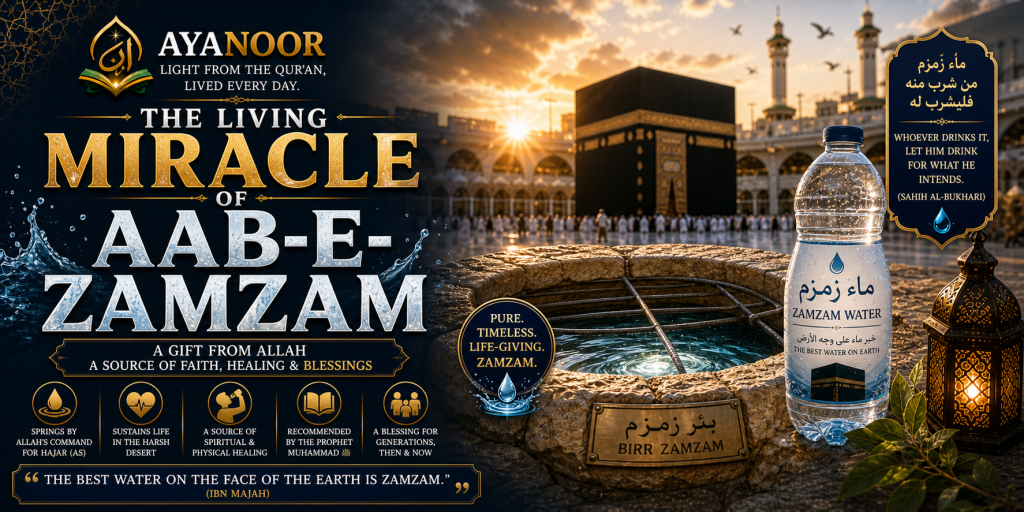
There are some blessings in this world that don’t just exist — they speak. Aab-e-Zamzam is one of them.
For over four thousand years, this well in the sacred city of Mecca has continued to flow — quietly, steadily, without interruption. No river feeds it. No rainfall sustains it in the way we understand water systems today. Yet millions drink from it every year, and it never runs dry.
For a believer, this is not just a historical curiosity — it is a sign.
A Beginning Rooted in Trust
The story of Zamzam begins with a moment of unimaginable faith. Prophet Ibrahim (peace be upon him) left his wife Hajar and their infant son Ismail in the barren desert, by the command of Allah.
No water. No shade. No life.
When Hajar asked, “Has Allah commanded you to do this?” and Ibrahim replied yes, her response defined generations:
“Then He will not abandon us.”
When the water ran out, she ran desperately between the hills of Safa and Marwah searching for help — seven times, driven by a mother’s love and trust in Allah.
And then, the miracle.
At the feet of baby Ismail, the earth opened — and water began to flow.
This was Zamzam.
A Well That Defies Time
From that moment until today, Zamzam has never ceased. Despite the harsh desert climate, despite the millions who drink from it daily — especially during Hajj and Umrah — it continues to replenish.
Modern studies have examined its composition and flow, but none can fully explain its endurance. It does not behave like a typical groundwater source. It is consistent, pure, and remarkably stable.
For believers, its “survival” is not the miracle —
its purpose is.
How Allah Points to It in the Qur’an
While the well itself is not named directly in the Qur’an, its story is deeply embedded in the legacy Allah highlights — the legacy of Ibrahim and the sacred house he built.
Allah says: “Indeed, the first House [of worship] established for mankind was that at Bakkah — blessed and a guidance for the worlds.”
(Surah Aal-Imran 3:96)
The Kaaba, near which Zamzam flows, is described as a place of barakah (blessing) and guidance. Zamzam is part of that divine environment — not separate from it.
And when Ibrahim made dua for this barren land, he said:
“Our Lord, I have settled some of my descendants in an uncultivated valley near Your sacred House…”
(Surah Ibrahim 14:37)
An uncultivated valley — lifeless, dry, empty.
Yet today, it is the most visited place on earth, sustained by a source of water that began with a miracle.
More Than Water
The Prophet Muhammad ﷺ described Zamzam in a way that goes beyond physical explanation:
“The water of Zamzam is for whatever it is drunk for.”
This transforms Zamzam from a resource into a relationship.
People drink it for healing.
For strength.
For forgiveness.
For hope.
And countless hearts testify — it responds.
A Lesson That Still Flows
The miracle of Zamzam is not only that water came from the ground.
It is that it came after trust.
Hajar ran — but she also believed.
Ibrahim left — but he relied on Allah.
And Allah responded — not just for them, but for all of humanity.
Every sip of Zamzam carries that message:
When you trust Allah in your emptiness, He can open for you what you never imagined.
The Ayanoor Reflection
In a world where we measure everything through logic and systems, Zamzam gently reminds us:
Not everything that flows is explained.
Some things flow because they are blessed.
And perhaps the real question is not how Zamzam has survived for so long —
but whether we are still able to recognize a miracle when we see one.
Ayanoor — Light from the Qur’an, lived every day.
Leave a Reply