
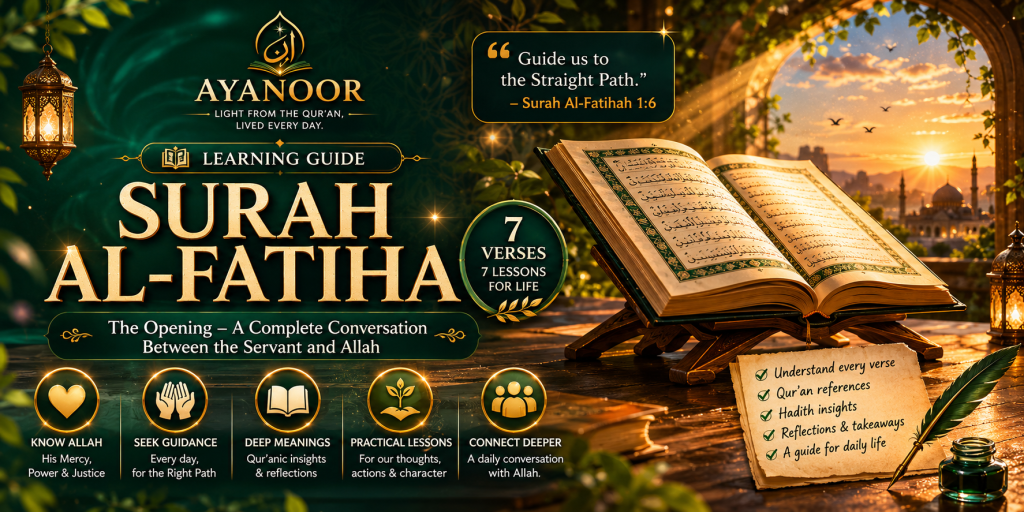
“The Opening” — A Complete Conversation Between the The Prophet Mohammad PBUH and Allah
Introduction
Surah Al-Fatihah is the first chapter of the Qur’an and one of the most important surahs in Islam. Every Muslim recites it multiple times a day in prayer. Yet beyond memorization lies a deep ocean of meaning, mercy, guidance, and connection with Allah.
The Prophet Muhammad ﷺ described it as the greatest chapter in the Qur’an.
“By Him in Whose Hand is my soul, Allah has not revealed in the Torah, the Gospel, the Psalms, or the Furqan anything like it.”
— Sahih al-Bukhari
Surah Al-Fatihah teaches us:
- Who Allah is
- Who we are
- Why we need guidance
- How to speak to Allah
- What path leads to success
The Seven Verses of Surah Al-Fatihah
1. بِسْمِ اللَّهِ الرَّحْمَٰنِ الرَّحِيمِ
“In the name of Allah, the Most Compassionate, the Most Merciful.”
Everything begins with Allah.
Before speaking, eating, learning, working, or traveling, Muslims begin with the name of Allah to seek His blessing and help.
Reflection
This verse teaches humility. We do not rely only on ourselves. We begin by remembering the One who gave us life, strength, and opportunity.
Qur’an Connection
Allah says:
“And rely upon the Ever-Living who does not die.”
— Surah Al-Furqan 25:58
2. الْحَمْدُ لِلَّهِ رَبِّ الْعَالَمِينَ
“All praise belongs to Allah, Lord of all worlds.”
Allah is the Rabb — the Sustainer, Caretaker, and Nurturer of everything.
He provides for:
- humans,
- animals,
- oceans,
- galaxies,
- even creatures hidden beneath the earth.
Reflection
Every blessing we enjoy ultimately comes from Allah:
- food,
- family,
- health,
- safety,
- knowledge,
- opportunities,
- even the ability to breathe.
Qur’an Connection
“And whatever blessing you have — it is from Allah.”
— Surah An-Nahl 16:53
3. الرَّحْمَٰنِ الرَّحِيمِ
“The Most Compassionate, the Most Merciful.”
Allah repeats His mercy immediately after introducing Himself as Lord.
Why?
Because His relationship with creation is built upon mercy.
Difference Between the Two Names
- Ar-Rahman → Allah’s vast mercy for all creation
- Ar-Raheem → Allah’s special mercy for believers
Reflection
No matter how many mistakes we make, Allah’s mercy remains greater.
Qur’an Connection
“My mercy encompasses all things.”
— Surah Al-A‘raf 7:156
4. مَالِكِ يَوْمِ الدِّينِ
“Master of the Day of Judgment.”
This verse reminds us that life has accountability.
One day:
- wealth will not help,
- status will disappear,
- excuses will end.
Only truth, sincerity, and deeds will matter.
Reflection
This verse balances hope with responsibility.
Allah is Merciful — but also Just.
Qur’an Connection
“So whoever does an atom’s weight of good will see it, and whoever does an atom’s weight of evil will see it.”
— Surah Az-Zalzalah 99:7–8
5. إِيَّاكَ نَعْبُدُ وَإِيَّاكَ نَسْتَعِينُ
“You alone we worship, and You alone we ask for help.”
This is the central message of Islam.
We worship Allah alone:
- without partners,
- without intermediaries,
- without idols,
- without ego.
And we seek help from Him first.
Reflection
Even strong people need Allah.
Every success ultimately comes from His permission.
Qur’an Connection
“And your Lord says, ‘Call upon Me; I will respond to you.’”
— Surah Ghafir 40:60
6. اهْدِنَا الصِّرَاطَ الْمُسْتَقِيمَ
“Guide us to the Straight Path.”
Notice:
Even believers ask for guidance every day.
Why?
Because guidance is not a one-time event.
It is a lifelong journey.
The Straight Path Includes:
- truth,
- sincerity,
- justice,
- patience,
- mercy,
- worship,
- good character.
Reflection
A person may know the truth but still need strength to follow it consistently.
Qur’an Connection
“Indeed, Allah guides whom He wills to a straight path.”
— Surah Al-Baqarah 2:213
7. صِرَاطَ الَّذِينَ أَنْعَمْتَ عَلَيْهِمْ
“The path of those upon whom You have bestowed favor…”
Allah teaches us to seek the company and example of righteous people.
Who Are They?
The Qur’an explains:
“The prophets, the truthful, the martyrs, and the righteous.”
— Surah An-Nisa 4:69
غَيْرِ الْمَغْضُوبِ عَلَيْهِمْ وَلَا الضَّالِّينَ
“Not the path of those who earned anger, nor those who went astray.”
This teaches us two dangers:
- Knowing truth but rejecting it
- Acting without knowledge or guidance
Islam calls us to combine:
- knowledge,
- sincerity,
- humility,
- and obedience.
A Beautiful Hadith About Surah Al-Fatihah
Allah says in a sacred Hadith:
“I have divided prayer between Myself and My servant into two halves…”
Each time the servant recites a verse of Al-Fatihah, Allah responds.
When the servant says:
“All praise belongs to Allah…”
Allah says:
“My servant has praised Me.”
This means Surah Al-Fatihah is not merely recitation —
it is a direct conversation with Allah.
— Sahih Muslim
Lessons We Learn from Surah Al-Fatihah
1. Everything Begins with Allah
Success starts by remembering Him.
2. Gratitude Changes the Heart
The believer notices blessings everywhere.
3. Allah’s Mercy Is Greater Than Our Sins
Never lose hope.
4. Life Has Purpose and Accountability
Our actions matter.
5. We Need Allah Every Day
Strength, guidance, patience, and wisdom all come from Him.
6. Guidance Is a Lifelong Journey
We must keep learning and improving.
7. The Best Path Is the Path of Truth and Balance
Not extremism. Not arrogance. Not ignorance.
Reflection Questions
- Which verse of Surah Al-Fatihah touches your heart the most?
- How often do we truly reflect while reciting it in prayer?
- What does “the straight path” mean in daily life?
- How can we increase gratitude to Allah?
- What distractions pull us away from guidance?
Ayanoor Takeaway
Surah Al-Fatihah is not only the opening of the Qur’an.
It is:
- a map for life,
- a daily reminder,
- a prayer for guidance,
- and a conversation between the servant and Allah.
Every time we recite it sincerely, we reconnect with our Creator.
“Guide us to the Straight Path.”
A prayer repeated by millions ev
day —
yet powerful enough to transform an entire life.
AYANOOR
Light From The Qur’an, Lived Every Day.
:::