
Understanding Hidden Dependence in Everyday Life
One of the greatest teachings of Islam is Tawheed — recognizing that ultimate power, control, authority, and ownership belong only to Allah.
Most people understand shirk as worshipping idols or praying to someone besides Allah. But there is another danger that can quietly enter the heart without us realizing it: emotionally depending on people as though they control our destiny.
This is not always spoken with words. Sometimes it appears in our thoughts, fears, hopes, anxieties, and emotional attachment to outcomes.
Allah reminds us repeatedly in the Qur’an that no person possesses independent power over benefit or harm.
The Illusion of Human Control
Imagine you attend a job interview.
After the interview, your thoughts become consumed by the interviewer:
- “He liked me.”
- “She probably rejected me.”
- “That manager controls my future.”
- “If this person says no, my life will collapse.”
Without realizing it, the heart slowly begins attaching itself to a human being as though that person independently controls provision, success, or destiny.
But Islam teaches something deeper:
The interviewer may conduct the interview — but only Allah opens doors.
The manager may sign a document — but only Allah allows outcomes to happen.
The doctor may prescribe medicine — but only Allah grants healing.
The investor may provide funding — but only Allah creates success.
The teacher may guide — but only Allah opens hearts to understanding.
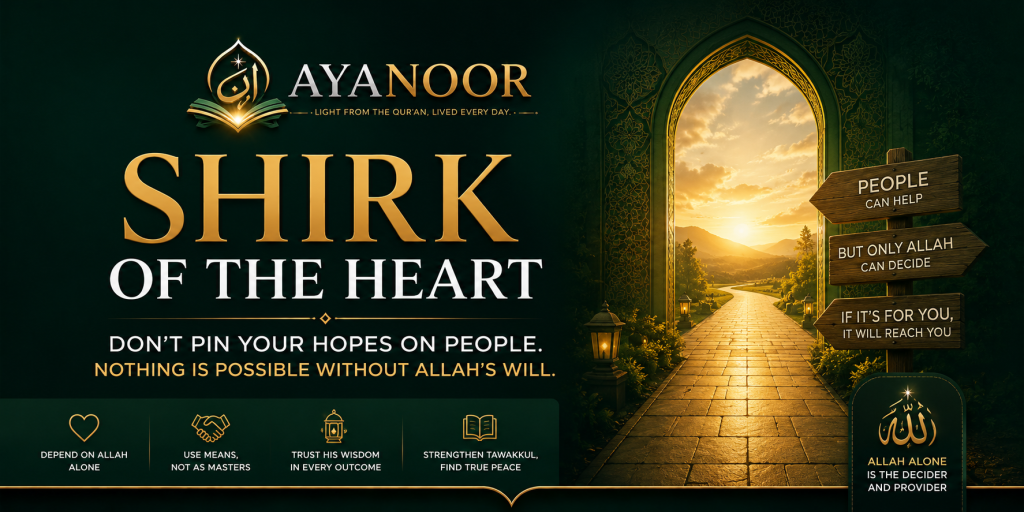
People are means. Allah alone is the Source.
What Is Hidden Shirk of Dependence?
This does not mean we stop interacting with people or using worldly means. Islam encourages effort, planning, excellence, and responsibility.
The problem begins when:
- our hearts become emotionally dependent on creation,
- we believe someone independently controls our future,
- or we lose peace because we think everything depends on human approval.
This is why scholars often spoke about “attachment of the heart.”
A believer works hard, applies for jobs, attends interviews, studies, seeks treatment, builds businesses, and consults experts — but internally knows:
“Nothing reaches me unless Allah wills it.”
Qur’anic Foundations
Allah says:
“And if Allah touches you with harm, none can remove it except Him. And if He intends good for you, none can repel His bounty.”
— Surah Yunus 10:107
And Allah says:
“Say: Never will we be struck except by what Allah has decreed for us.”
— Surah At-Tawbah 9:51
Another powerful reminder:
“And whoever relies upon Allah — then He is sufficient for him.”
— Surah At-Talaq 65:3
This verse does not say:
“Whoever relies upon people…”
It says Allah alone is sufficient.
The Difference Between Using Means and Worshipping Means
Islam does not teach passivity.
A farmer still plants seeds.
A student still studies.
A patient still visits a doctor.
A businessperson still meets investors.
But believers understand:
- the seed does not grow by itself,
- knowledge does not benefit without Allah,
- medicine does not heal independently,
- and wealth does not arrive except by Allah’s permission.
The means are not the Creator of the result.
This understanding protects the heart from disappointment, arrogance, panic, and emotional slavery to people.
Why This Matters Spiritually
When people begin depending too heavily on creation:
- anxiety increases,
- fear of rejection grows,
- people-pleasing takes over,
- moral compromise becomes easier,
- and faith weakens.
But when the heart reconnects to Allah:
- inner peace returns,
- patience becomes easier,
- rejection hurts less,
- success produces gratitude instead of arrogance,
- and failure becomes a lesson rather than destruction.
A Healthier Way to Think
Instead of saying:
“That person controls my future.”
Train the heart to say:
“If Allah has written this for me, nobody can stop it. If Allah has not written it for me, nobody can force it.”
Instead of:
“I hope this person gives me success.”
Say:
“O Allah, if this is good for me, open the door. If not, guide me to what is better.”
This mindset creates emotional freedom.
The Story of Musa (AS)
When Prophet Musa (AS) fled Egypt alone, frightened, homeless, and uncertain about the future, he arrived in Madyan with nothing.
After helping two women water their flock, he turned to Allah and said:
“My Lord, truly I am in desperate need of whatever good You send down to me.”
— Surah Al-Qasas 28:24
He did not attach his heart to people.
He turned directly to Allah.
Shortly afterward:
- shelter came,
- work came,
- family came,
- and stability came.
The lesson is profound:
Provision comes from Allah through people — not from people independently.
Everyday Examples of Hidden Dependence
In Careers
Believing a boss completely controls your future.
In Marriage
Believing happiness can only come through one specific person.
In Business
Thinking investors, clients, or markets independently control success.
In Health
Believing doctors alone heal.
In Social Life
Becoming emotionally dependent on praise, validation, or acceptance from others.
Signs of Healthy Tawakkul
A believer:
- works hard,
- plans wisely,
- respects people,
- appreciates opportunities,
- and fulfills responsibilities,
while internally remaining attached only to Allah.
Such a person:
- does not become arrogant in success,
- does not collapse in rejection,
- and does not lose hope after setbacks.
Because their certainty is not in people —
their certainty is in Allah.
Reflection Questions
- Have I become emotionally dependent on someone for my happiness or future?
- Do I panic when people reject me?
- Do I believe opportunities come only through certain individuals?
- How often do I turn to Allah before turning to people?
- Do I trust Allah’s wisdom when doors close?
Final Reflection
People may open doors —
but only because Allah allowed them to.
People may reject opportunities —
but they cannot block what Allah has written.
The believer’s heart remains calm because they know:
No human being owns provision, success, guidance, healing, or destiny.
Allah alone is Al-Razzaq (The Provider), Al-Fattah (The Opener), and Al-Wakeel (The Trustee over all affairs).
If something is truly meant for you, it will reach you by Allah’s permission.
And if it does not reach you, then Allah knows something you do not.